The screens exist, the app does not
A previous vendor built the interface, but the build keeps failing App Store review and nobody can answer the reviewer. Every reply starts a new review cycle — and another week.
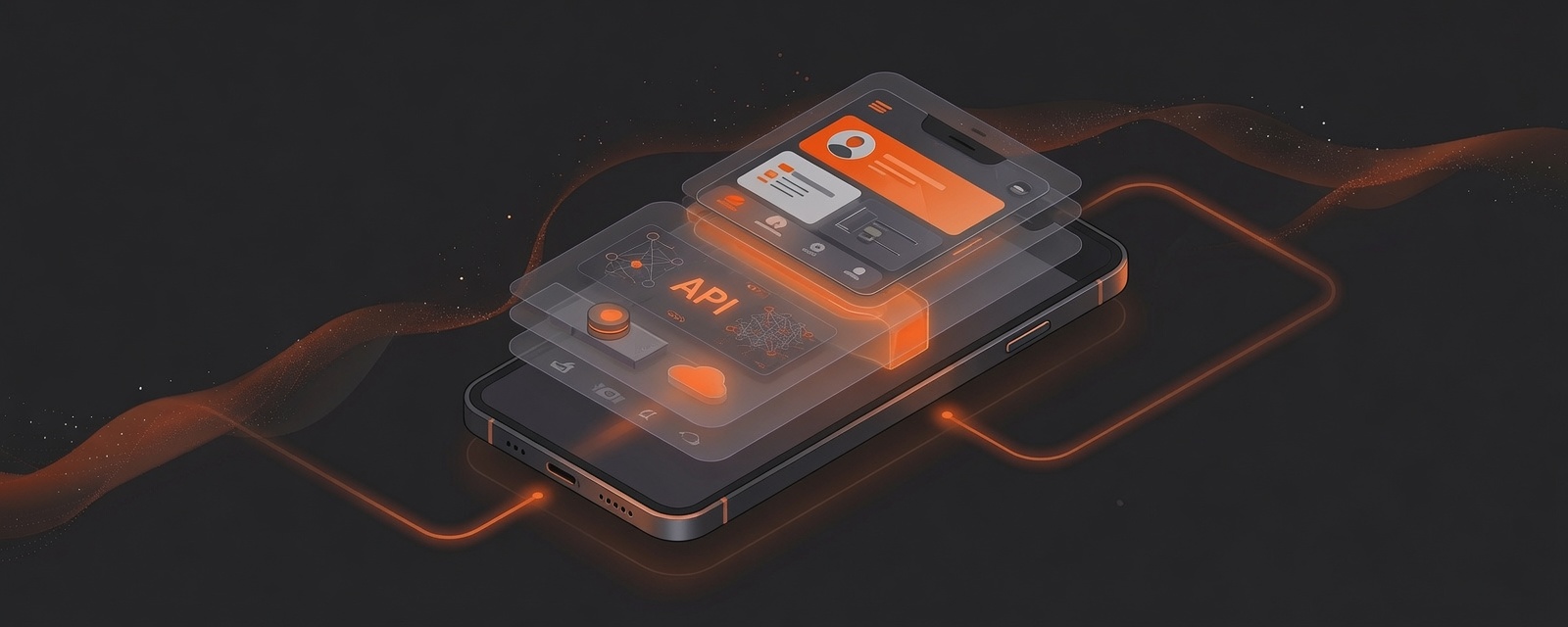
We design, build and publish mobile applications — native and cross-platform. Backend, integrations and the release to the App Store and Google Play are on us. You receive an app that is live in the stores, not a folder of screens waiting to ship.
A previous vendor built the interface, but the build keeps failing App Store review and nobody can answer the reviewer. Every reply starts a new review cycle — and another week.
A customer searches for you in the App Store, finds nothing, and signs in through the browser again. Your competitor owns the home-screen icon — you do not.
One team builds iOS, another builds Android, and within months the same screen behaves differently on each phone. You agree every fix twice — and wait twice as long.
Navigation, gestures and typography per HIG and Material Design
Local storage and sync on reconnection
Delivery through APNs and FCM, segmentation, a settings screen
A connection to your system, or a backend from scratch
Store listings, certificates, data declarations, review submission
Funnel events and crash reports tagged with the build number
We break the idea into a list of screens and features, and settle what belongs in the first version. We walk the flow the way a user would, to catch the screens nobody thought of. This is also where native or cross-platform is decided.
We draw wireframes and a clickable prototype built to both platform guidelines. We put the prototype on your own phone, so you walk the whole flow with a thumb rather than on a laptop screen. We rework the layout until the path is obvious without explanation.
We build the app and the backend in parallel. We ship a build through TestFlight and Google Play internal testing every week, so progress shows on a device rather than in screenshots. We close features one at a time, starting with the core scenario.
We test on older and newer models, on weak connections and after the network drops. We reproduce real situations: a lift, a metro carriage, an interrupted payment, a call mid-form. We fix whatever surfaces before the build goes to the store.
We prepare the App Store and Google Play listings, configure certificates and data declarations. We submit the build for review and answer reviewer feedback on your behalf. Review timing belongs to Apple and Google, so we give it as a range rather than a promise.
We watch crashes, ship fixes and prepare the app for the annual iOS and Android releases. We test each build on the system beta before the update reaches your users. New features are planned into later releases.
There is no single right answer here — there is a trade between speed and control. For business apps we usually propose cross-platform; for graphics and real-time processing, native. The call is made after we go through the feature list.
| Native (Swift / Kotlin) | Cross-platform (React Native / Flutter) | |
|---|---|---|
| Time to first version | Two apps; the same screen built twice | One codebase; one screen for both systems |
| Development effort | Two implementations, two skill sets: Swift and Kotlin | One codebase; less gain when screens diverge per platform |
| Performance | Games, heavy 3D, long camera sessions, video processing | Lists, forms, maps, chat, payments — most business apps |
| Access to device features | Full access from day one; new system APIs immediately | Camera, GPS, push, Bluetooth, biometrics via ready-made modules |
| Long-term maintenance | Two repositories, two release tracks; Apple and Google only | One fix for both platforms; plus a framework dependency |
Not every idea needs a store listing. Three cases where the honest answer is no.
If you do not know whether people will use it, a web app answers that faster and cheaper. With no review, no certificates and no second platform, the first users reach the product the same week. The store is where we go once it is clear what belongs inside.
A catalogue, a blog or a contact form does not need installing. People open it in a browser anyway, and Apple rejects apps that are a wrapped website. That is guideline 4.2 of the App Store rules, and a rejected build comes back to you days later.
A mobile app needs a release for every major iOS and Android version, and those ship every year. Without maintenance planned in, crashes start on new phones within a year and the listing disappears within two. We set maintenance in a separate agreement before the build starts.
Scope sets the figure: the number of screens and roles, offline mode, payments and integrations. You get the quote and the schedule after discovery, before anything is signed.
3–5 weeks to the first working version, once scope is agreed. A full app with payments and offline mode is usually 2–4 months. Store review is added on top, and Apple sets that timing.
Cross-platform for most business apps: one codebase and one fix that reaches both stores. We go native for graphics, real-time camera work and brand-new system APIs. The call comes after we read the feature list.
Yes, publishing is on us. We prepare the listings, configure certificates, submit the build for review and answer the reviewers. Developer accounts are registered to your company.
We connect to what you already run. If the backend exposes an API, we build only the mobile layer and add whatever endpoints are missing. Screens are redesigned for iOS and Android guidelines.
Yes, from the first day of work. Code lands in a repository on your account, along with architecture docs, a release runbook and the store console accounts. Another team can take it over.
Crash monitoring, bug fixes, dependency updates and the releases forced by new iOS and Android versions. Those ship every year, and without them an app stops working over time. Feature work is quoted separately.